

Story of the Khon (from Dancing With The World, vol. 2)
Wynn-Anne Rossi Late Elementary
Digital Download
Printed Edition
Bhangra Meets Bollywood (from Dancing With The World, vol. 2)
Wynn-Anne Rossi Late Elementary
Digital Download
Printed Edition
Deep Purple Tango (from Dancing With The World, vol. 2)
Wynn-Anne Rossi Early Intermediate
Digital Download
Printed Edition
Sidewalk Lindy Hop (from Dancing With The World, vol. 2)
Wynn-Anne Rossi Early Intermediate
Digital Download
Printed Edition
Whirling Dervish (from Dancing With The World, vol. 2)
Wynn-Anne Rossi Late Elementary
Digital Download
Printed Edition
Wild Hopak (from Dancing With The World, vol. 2)
Wynn-Anne Rossi Early Intermediate
Digital Download
Printed Edition
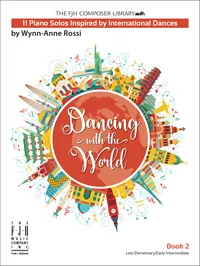
This week, we’re taking a musical trip around the world with Wynn-Anne Rossi’s newly released series Dancing With the World.
Designed as a four-volume collection spanning multiple levels, the series explores traditional dance styles from a variety of cultures and transforms them into engaging piano repertoire for students. In this episode, I’m focusing on six selections from Volume 2, written for late-elementary and early-intermediate pianists.
Along the way, we’ll explore the dances that inspired these pieces and consider why Dancing With the World could become a wonderful framework for a themed recital, summer camp, or studio-wide project.
Pack your dancing shoes and your passport!
— Transcript —
Themes, themes, themes. We piano teachers love a good theme. Whether it’s for a themed recital, or a theme for a summer camp, we’re simply adding a little narrative to the usual teaching routine.
Themes provide a way to connect pieces together into a larger musical experience. They create a sense of shared purpose among students. Today, we’re returning to the music of Wynn-Anne Rossi and her newest release titled, Dancing With the World.
It’s a four-volume-themed collection that focuses on the music of traditional dances across various cultures. I’ve got six of them queued up for you, all at the late elementary to early intermediate level.
From Thailand to India, Argentina to New York, it’s time to lace up your dancing shoes for what’s coming up next on the Piano Pedagogy Playlist. Greetings and welcome. I hope your day is going well.
My name is Luke Bartolomeo. I’m a pianist, a teacher, and also a developer of music education apps, including Rhythm Swing. Each Monday on the Piano Pedagogy Playlist, we explore teaching repertoire that is practical, engaging and meaningful.
All of it written by living composers. Wynn-Anne Rossi writes that the goal of this collection was to bring the joy of international dance into the piano studio and to celebrate cultures through movement and music.
She encourages students to watch performances of the dances and even try some dance steps themselves. Now, there’s a recital or camp idea for you, combining music and dance.
For our first pairing of dances, we’ll begin in Thailand with a composition called Story of the Khon. Khon is a dramatic performance tradition in Thailand that dates back centuries.
The dancers use stylized gestures and angular movements, inspired by martial arts, to tell stories. A variety of contrasting moods gives the performer some interesting material to work with.
And that’s really the secret to a convincing performance of this piece. It needs to feel like a story is being told. After that, we’re moving on to India, and something inspired by tradition and Bollywood.
The piece is called Bhangra Meets Bollywood, the Bhangra being a high-energy folk dance from Northern India. It’s become something of a global sensation, largely due to it being featured in Bollywood movies.
It’s often used in the big production number style scenes, taking place at weddings or festivals. Here are our first two dances from Wynn-Anne Rossi’s Dancing With the World, Volume 2. First, Story of the Khon, and then Bhangra Meets Bollywood.
Our middle pairing of pieces takes place in the Americas, starting in Argentina. Deep Purple Tango sits right at the center of Argentine culture, and Rossi describes it as a dance driven by strong emotion and distinct rhythm patterns.
I don’t think I’ve ever met a student who wasn’t at least a little bit curious upon hearing that distinctive tango rhythm. From South America, we moved to the streets of New York City with sidewalk Lindy Hop.
The Lindy Hop emerged in Harlem during the swing era of the 30s and 40s, blending jazz and tap influences with that famous swing out movement.
It can truly be thought of as an American folk dance, something that originated not in a ballroom, but out on the streets.
It had a huge resurgence in popularity in the 80s and 90s, and continues to be widely popular and practiced throughout the world. Two uniquely American forms of dance, here is Deep Purple Tango and sidewalk Lindy Hop.
Whirling Dervish is the first of our final two pieces today. Now, I don’t know about you, but whenever I’ve heard the term Whirling Dervish, it’s been used to refer to someone with an abundance of energy or someone who is multitasking like a madman.
Interestingly, though, the whirling referred to is actually a meditative practice employed by some followers of the Sufi branch of Islam. The dancers gracefully spin as a way to abandon their egos and draw closer to God.
Musically, it’s a good piece for starting to develop some finger speed and control in the right hand.
After a calm start, the final section of the piece includes just the right amount of eighth notes to allow late beginner level students the chance to experiment with some simple passage work.
I’ll then close with an energetic finale from Ukraine, Wild Hopak. The Hopak gets its name from a Ukrainian word meaning to jump.
Historically, it was performed by military men in a celebratory dance full of squatting and leaping and displays of athletic energy. I have a feeling you might have an image in your mind of this already.
Our version ends with an achillerando that races to a victorious conclusion. Our final two dances today, Whirling Dervish from Turkey and Wild Hopak from Ukraine.
The pieces I played today were from Wynn-Anne Rossi’s new series, Dancing With the World. And all of today’s selections came from Volume 2 for Late Beginner and Early Intermediate Students.
But remember, there are three other volumes ranging from Beginner all the way to Late Intermediate.
So if you wanted to take this idea and run with it for a summer camp or a recital, you should have no problem finding a suitable piece for students at every level. Each of the four volumes are available in both printed and digital forms.
And you also have the option of purchasing and downloading pieces individually. Purchasing links can be found in the episode description or by heading over to our website at pianopedagogyplaylist.com.
And just like that, it’s time to close the lid on this week’s episode of the Piano Pedagogy Playlist.
I’ll look forward to seeing you again next Monday when I’ll share some more of my current favorites from the contemporary piano teacher’s repertoire. Until then, keep nurturing the music, and have a great week.
Leave a Reply