


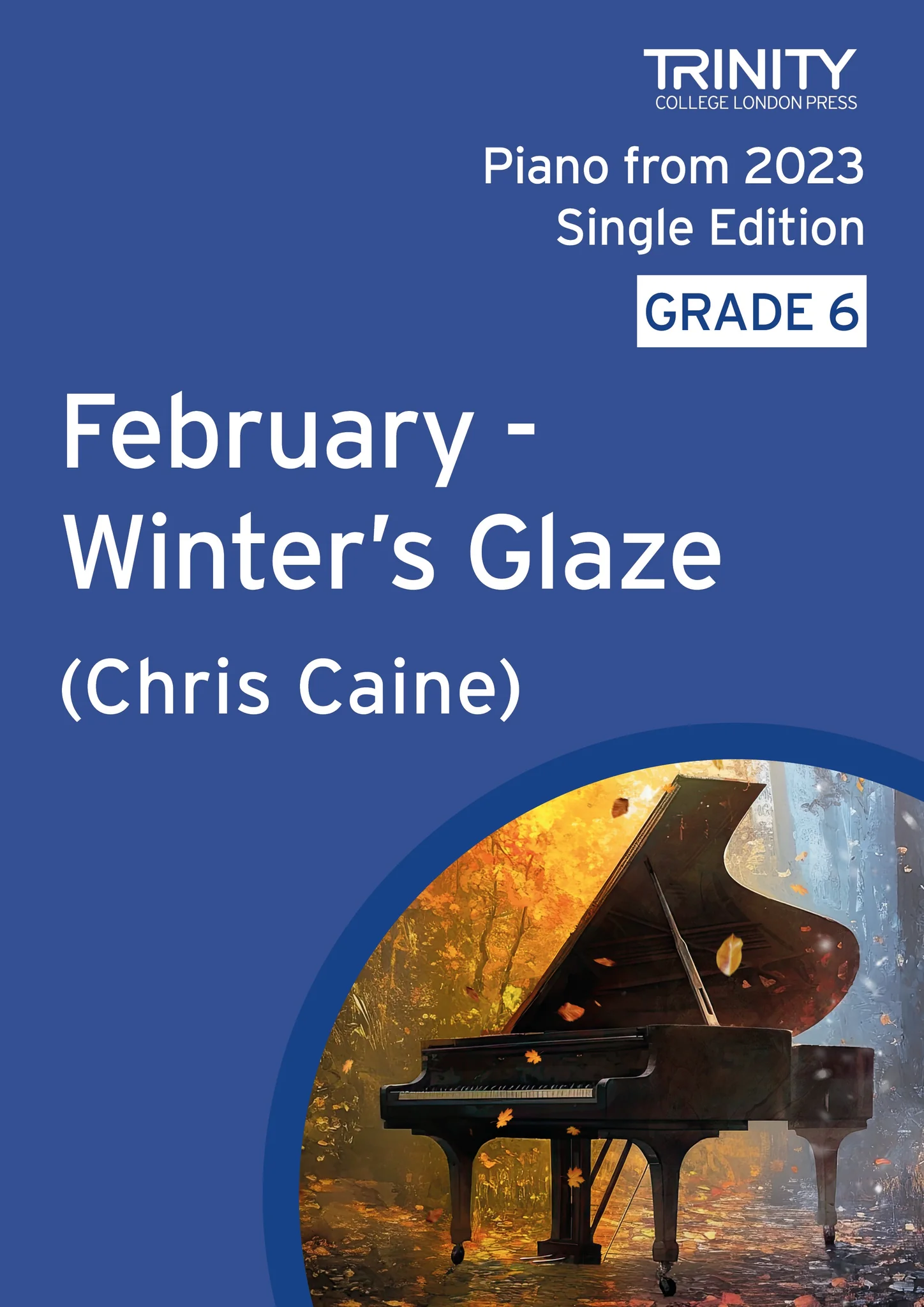
February – Winter’s Glaze (from A Year in 12 Keys)
Chris Cane Late Intermediate
Digital Download
Printed Edition

Taking My Master For A Walk (from A Day in the Life of a Dog)
Wynn-Anne Rossi Early Intermediate
Digital Download
Printed Edition
Faithful Friend (from A Day in the Life of a Dog)
Wynn-Anne Rossi Early Intermediate
Digital Download
Printed Edition
Morning Frenzy (from A Day in the Life of a Dog)
Wynn-Anne Rossi Early Intermediate
Digital Download
Printed Edition
Our journey through, A Year in Twelve Keys continues with “February — Winter’s Glaze” by Chris Caine, a brief but atmospheric piece written in the uncompromising key of C-sharp major — seven sharps, shifting meters, and a quietly icy finish.
With a major Sunday event on the horizon, the episode then takes a turn toward lighter, more playful territory, featuring three short works by Wynn-Anne Rossi. These early-intermediate pieces offer strong pedagogical value — left-hand melody, Alberti bass patterns, legato pedaling, and lively rhythmic work — all wrapped in music full of youthful energy.
— Transcript —
Last month, we kicked off a year-long journey, exploring a work titled A Year in 12 Keys by composer Chris Caine, one piece for each month of the year. Each piece is in a different key.
But what makes the set especially interesting is that every one of them is completely diatonic. No added sharps, flats, or naturals, no alterations to what is in the key signature.
It’s a really elegant way to help even more advanced students deepen their sense of what it feels like to live inside a particular key. Today we’re moving on to this month’s piece called February, Winter’s Glaze.
Now it’s a very short work, but it packs in a surprising amount of atmosphere, as well as a slightly alarming number of sharps in the key signature.
And since it is a brief piece and since there seems to be a certain big game happening this coming Sunday here in the US., I thought we’d spend the rest of our time with some pieces that tie into that.
Music that paints an icy picture with more sharps than you can shake a stick at. Coming up on the Piano Pedagogy Playlist. Greetings and welcome to the Piano Pedagogy Playlist.
I hope your day is going well. My name is Luke Bartolomeo. I’m a pianist, a teacher, and also the developer of music education apps, including Flashnote Derby.
Each Monday on the Piano Pedagogy Playlist, I play for you some of my current favorites from the contemporary piano repertoire, pieces written for students by living composers. Music of Our Own Time.
Last month’s piece from A Year in Twelve Keys felt almost like a show tune, bright, welcoming in the no-stress key of C major. This month, not so much.
February Winter’s Glaze is a quiet, introspective exploration of cold, and it’s written in what appears to be the key of C sharp major.
So quickly run through in your mind whatever mnemonic device you use to remember the order of sharps in the key signature, and you’ll realize that we’ll be using all of them.
Seven sharps, the composer’s equivalent of saying, yes, we’re doing this the hard way. As I’m sure you’re well aware, C sharp major shares all of its pitches with D flat major, which accomplishes the same thing with just five flats.
So why would a composer ever choose the more complicated option? My personal opinion, whatever theoretical reasoning they might have, it’s not especially satisfying from a performer standpoint.
I think most of us would agree we’d much rather see five flats than seven sharps on the page. If there’s someone listening who legit would prefer reading a piece in C sharp rather than D flat, I’d love to hear from you.
Still, despite the initial headache that ensued from trying to remember not one, but two white key sharps, this was honestly a fascinating piece to learn and record. The harmonies are mildly dissonant but never harsh.
The meter shifts between cut time and 6-8. And the left hand melodic gestures are often entirely out of sync with those in the right hand. What really struck me was how different the piece feels to listen to compared with what it feels like to play.
Without the score in front of you, it is easy to feel rhythmically adrift, unsettled. Which turns out to be a pretty good match for how I am often feeling when February rolls around.
The holidays are a distant memory, and it is too early to be dreaming about spring. The piece closes in just under 60 seconds, with a chord that contains all seven notes of the key sounding at once. It is actually a beautifully icy finish.
Here is February Winter’s Glaze by Chris Cane. So, February is a month that has its challenges, and it can be a bit of a slog to get through. But it does have one event that unites all Americans in front of TV screens across the country.
Of course, I’m referring to the Puppy Bowl, which takes place each year on the same day as some other thing called the Super Bowl. It features puppies from animal shelters, all in need of homes.
And by the end of the broadcast, they’re inevitably adopted. It’s sweet, a little ridiculous, and honestly one of the best traditions of Super Bowl Sunday, in my opinion.
With that in mind, I’ve put together a brief musical triptych from Wynn-Anne Rossi’s A Day in the Life of a Dog, written for early intermediate students. They’re all short pieces, so I’ll play them together in a set.
The first is called Taking My Master For A Walk. It perfectly captures the bouncy excitement of going for a walk, the highlight of any dog’s day.
Pedagogically, it’s especially nice because the left hand gets a turn at the melody and also at a bit of Alberti bass style accompaniment, a pattern that will show up again and again later as they are introduced to sonatina literature.
In the middle of our trio is a sweet piece called Faithful Friend. It’s a simple piece that could be tackled by a late elementary student. And yes, I did just use the word tackle to show you that indeed, I do know how football works.
One thing I really appreciate about this selection is the gentle introduction of legato pedaling in just short isolated moments.
It’s such a smart way to teach the technique, allowing students to master it in small doses before it becomes something they try to apply consistently across longer passages.
I’ll end with what is actually the beginning, a piece called Morning Frenzy. Most dogs wake up bursting with energy, ready to take on the day.
We, however, here live with our 10-year-old great Pyrenees, who has reached a stage in life where she’s perfectly content to remain snuggled indoors for as long as possible, before eventually heading out to begin her daily backyard patrol.
This piece, however, is really giving young dog energy, and it’s an excellent technical workout, especially for the left hand. It’s also great rhythm practice, as it feels like there’s practically a new rhythm in every measure.
So, in anticipation of the Puppy Bowl, here is my little suite of pieces from Wynn-Anne Rossi’s A Day in the Life of a Dog. First, Taking My Master For a Walk, followed by Faithful Friend, and finally, Morning Frenzy.
Today, we’ve explored music by two living and very active composers, beginning with February’s Icy Reflection from Chris Caine’s A Year in Twelve Keys, followed by three charming K-9 inspired pieces by Wynn-Anne Rossi.
You’ll find links to where you can purchase all of today’s music in the episode description, or you can visit pianopedagogyplaylist.com and explore our full archive of episodes.
And just like that, it’s time to close the lid on today’s episode of the Piano Pedagogy Playlist.
No matter which team you’re rooting for in the big game this Sunday, or even if you couldn’t care less, I hope you’ll mark the occasion by enjoying plenty of your favorite comfort foods and not feeling guilty about it in the least.
I’ll look forward to seeing you again next Monday, when I’ll share some more of my current favorites from the contemporary piano teacher’s repertoire. Until then, keep nurturing the music, and have a great week.

Leave a Reply