

Sweet Mister Jelly Roll (from Portraits in Jazz)
Valerie Capers Late Intermediate
Printed Edition
Billie’s Song (from Portraits in Jazz)
Valerie Capers Early Intermediate
Digital Download
Printed Edition
The Monk (from Portraits in Jazz)
Valerie Capers Late Intermediate
Printed Edition
Bossa Brasilia (from Portraits in Jazz)
Valerie Capers Late Intermediate
Printed Edition
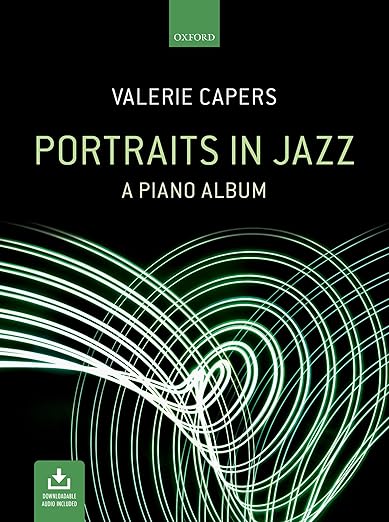
Finding jazz pieces that are both musically authentic and technically appropriate for developing pianists can be a challenge. In this episode of The Piano Pedagogy Playlist, I explore Portraits in Jazz by pianist and composer Valerie Capers—a standout collection that brings authentic jazz styles into the intermediate student repertoire.
Capers’ collection offers pieces that capture the spirit of ragtime, ballad, bebop, and bossa nova while remaining accessible.
And, seriously, there’s one of the loveliest pieces I’ve played in a while, at any level.
— Transcript —
One of the challenges we often face as piano teachers is finding quality, authentic jazz repertoire at a student-friendly level.
The musicians who really live in the jazz world aren’t always the ones writing their music out note for note, and when they do, it’s often beyond the technical or musical reach of many students. But every now and then, we come across a real gem.
Today’s music comes from a composer and pianist who is equally at home in both the jazz and classical worlds. And her collection that I’m featuring today is a real gift to the pedagogical repertoire.
Authentic jazz styles thoughtfully crafted for intermediate level students. Ambitious intermediate level students. I’m playing pieces from Portraits in Jazz by Valerie Capers.
Music that really carries the swing, the color, and the character of jazz into the student repertoire. Coming up next on The Piano Pedagogy Playlist. Greetings and welcome to another episode of The Piano Pedagogy Playlist.
I hope your day is going well. My name is Luke Bartolomeo. I’m a pianist, a teacher, and also a developer of apps for music education, including Flashnote Derby.
And if you use Flashnote Derby with your students to help them with their note reading, you might have noticed a fairly major update rolled out last week. It has some nifty new features. Ah, but that’s my day job.
Here on the podcast each Monday, for me, it’s playtime. I get to share some of my current favorites from the contemporary repertoire written for piano students by living composers.
And today we’re diving into four pieces from Portraits in Jazz by the wonderful Valerie Capers. We’ll start today with Sweet Mr.
2:11
Sweet Mr. Jelly Roll
Jelly Roll. The Jelly Roll in question, of course, was the ragtime pianist Jelly Roll Morton, the self-proclaimed inventor of jazz. This piece introduces students to the ragtime style in an accessible way.
We get the classic syncopations and a simplified stride style left hand that doesn’t overwhelm.
It’s a great choice for intermediate students who’ve moved beyond the simplified versions of the entertainer, but aren’t quite ready for the original version. Or for the full challenge of something like Maple Leaf Rag.
Which if you listen closely, you will hear a snippet of clearly quoted in this piece. Teachers who are using the Royal Conservatory of Toronto materials might know this piece already. It currently appears in the Level 6 Repertoire Book.
Here is Sweet Mr. Jelly Roll by Valerie Capers. When it comes to ragtime, once the notes are learned, students will invariably want to play it too fast.
It’s a great opportunity to remind them of Scott Joplin’s famous quote, It is never right to play ragtime fast. Next up, we have a lovely ballad dedicated to the incomparable jazz vocalist, Billie Holiday.
If you’re not yet familiar with Billie’s Song, it’s a must-have, and I don’t say that often, but it is a must-have in your intermediate-level jazz repertoire. It’s full of rich harmonies.
There’s dominant sevenths, major sevenths, ninths, expressive non-chord tones, all supporting a slightly melancholy melody. This is authentic jazz writing at a level students can manage.
But don’t be tempted to give this piece to too young of a student. The physical demands of covering those large intervals and dense chords need to be taken into consideration.
But for the student who has the physical maturity and the emotional sensitivity, this is just a devastatingly beautiful piece. Billie’s Song by Valerie Capers. Valerie Capers lost her sight at the age of six due to illness.
She studied classical piano as a child, learning to read music in Braille notation, and memorizing all of her repertoire that way. In 1960, she became the first blind graduate of the Juilliard School.
Around that time, she also began performing and composing in the jazz idiom, building a remarkable career as both a performer and educator. This collection, Portraits in Jazz, was published by Oxford University Press in 2000.
It grew out of her desire to help bridge the classical and jazz world for piano students.
8:47
The Monk
After all that beautiful lyricism, we turn to something a little more angular. The pianist Thelonious Monk was one of the foundational figures in the jazz style that became known as bebop.
And this next piece is a great introduction to the complex harmonies and jarring syncopations of that style. It really demands a strong internal pulse.
Without a drummer or a bassist to lock in the groove, some of these rhythms are really challenging to learn without the help of a metronome. A whole lot of effort, but a whole lot of fun. This piece is called simply The Monk.
Any jazz aficionados recognize the tune that was quoted there? That was, of course, the famous opening riff from one of Thelonious Monk’s signature pieces, Straight No Chaser.
11:04
Bossa Brasilia
So far in our set of portraits, we’ve explored ragtime, the jazz ballad, and a bit of bebop. To close, we move into the relaxed sway of a bossa nova.
Bossa Brasilia is easy and breezy on the surface, but unlike the last piece where the challenge is obvious, this one requires the rhythmic intricacy to be completely hidden. And that’s not easy for students.
Looking at the score, it doesn’t seem especially difficult. But for someone not used to this accompaniment style, it can be quite tricky. Listen for what I like to call the heartbeat rhythm in the left hand.
It anticipates the beat most of the time. Except when it doesn’t. That little rhythmic motive is sneaky, but it’s so characteristic of this style.
Set all your cares aside for a moment, and enjoy Bossa Brasilia.
13:46
Jazz Repertoire Resources
I guess it’s true that, by definition, jazz really isn’t jazz without improvisation. And these pieces are fully written out. They’re meant to be learned note for note, like you would classical repertoire.
But they also open up a new world of harmony and rhythm that is distinct to this great musical tradition.
And for students who are curious and motivated, each of these works could serve as a springboard into improvisation, using the harmonies and structures that Valerie Capers provides as a starting point.
The piece Billie’s Song is available for digital download, and all of today’s pieces are included in the printed edition of Portraits in Jazz, published by Oxford University Press.
As always, you can find links to where you can order this book online in the podcast description. Or if you’re able, support your local sheet music retailer and see if you can get them to stock this gem of a collection.
And just like that, it’s time for us to close the lid on today’s episode of The Piano Pedagogy Playlist. Whether it’s ragtime, bebop or bossa nova, jazz reminds us that the feel is everything.
I’ll look forward to seeing you again next Monday when I’ll share some more of my current favorites from the contemporary piano teacher’s repertoire. Until then, keep nurturing the music and have a great week.

Leave a Reply