


Prelude in C major (from Preludes in Patterns)
Kevin Olson Early Intermediate
Digital Download
Printed Edition
Prelude in a minor (from Preludes in Patterns)
Kevin Olson Early Intermediate
Digital Download
Printed Edition
Prelude in D major (from Preludes in Patterns)
Kevin Olson Early Intermediate
Digital Download
Printed Edition
Prelude in d minor (from Preludes in Patterns)
Kevin Olson Early Intermediate
Digital Download
Printed Edition
Prelude in g minor (from Preludes in Patterns)
Kevin Olson Early Intermediate
Digital Download
Printed Edition
Prelude in B♭ major (from Preludes in Patterns)
Kevin Olson Early Intermediate
Digital Download
Printed Edition
This week’s episode features music by Kevin Olson, a composer whose work many piano teachers already know and use in their studios..
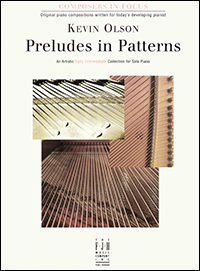
I’m sharing six short pieces from his collection Preludes in Patterns—a set of concise, pattern-based works that sound way more sophisticated than they are to learn.
Each piece is built from small, repeating ideas that help students quickly recognize patterns, build fluency, and gain confidence at the keyboard. The result is music that feels manageable under the hands while still sounding polished and impressive.
These preludes are especially useful in the studio as confidence-building repertoire, quick recital substitutions, or reliable pieces that come together in a shorter amount of time without sacrificing musicality.
If you’re looking for music that sets students up for success—both in lessons and on stage—this is a collection worth exploring.
— Transcript —
The past couple of weeks, we’ve discovered some fantastic music by some maybe lesser known composers. This week, we’re rediscovering someone most of you probably already know, and very likely teach his music already, Kevin Olson.
And I want to start with a situation that I think just about every teacher has experienced. You have a student who needs something for a recital or a festival.
Maybe the current piece they’ve been working on just isn’t coming together, or maybe they just need something that will help them feel successful again.
You need something that sounds impressive and feels satisfying to play, and can actually come together relatively quickly. That’s exactly what Kevin Olson gives us in his collection, Preludes in Patterns.
Pieces that are practical, pattern-based and pleasing to students and teachers alike. And I’ve got six of them on deck coming up next on the Piano Pedagogy Playlist.
Greetings and welcome. I hope your day is going well. My name’s Luke Bartolomeo. I’m a pianist, a teacher, and also the developer of Apps for Music Education, including Flashnote Derby.
Each Monday, we explore some of my current favorites from the contemporary repertoire of piano music written for students, all of it by living composers.
Today’s episode features music by Kevin Olson, a composer and teacher whose work many of you have likely encountered in your own studios. What makes his writing so effective is how directly it addresses real teaching needs.
These pieces today are built on small repeating patterns, ideas that are easy for students to wrap their brains around. But they create a much more sophisticated musical result than you might expect.
I’ll be sharing six short pieces today from his collection, Preludes in Patterns. These are concise works, most of them under a minute.
And since they don’t come with descriptive titles, we can let our minds create our own stories for each piece as we listen.
And as we go through these Preludes, see if you can perceive all of the ways the composer relies on small repeating ideas, both rhythmic and melodic, patterns that shift and evolve to create something that sounds more complex.
The first piece I’m going to play today is built around a simple repeating melodic idea, with shifting harmonies underneath to keep things interesting.
In the Prelude in C major, only one hand is ever doing the busy work at a time, so students can really focus on the evenness in their technique without having to think too much about coordinating both hands together.
I’ll then move to the Prelude in the related minor key, A minor, where we still have that same idea of repeating patterns over changing harmonies.
But instead of being flowing in legato, the second one is much more pointed, more staccato in character. There’s also a bit more rhythmic variety in the second Prelude, which introduces a light sense of syncopation.
Similar compositional ideas in both pieces, but focusing on completely different touches and different energy. Here is Kevin Olson’s Prelude in C major, followed by his Prelude in A minor. Moving on to our next pair of Preludes.
This time, I’ll go with a pairing, taking a piece in a major key, and then we’ll follow it with its parallel minor. So the D major Prelude is really quite clever. The right hand is largely playing very familiar shapes.
It’s broken major and minor triads. But because of the foundational tones established by the left hand, those same notes take on a much richer harmonic role.
Instead of representing the root and the third and the fifth as they would in a triad, what we hear is them functioning as the fifth and the seventh and the ninth, even the 11th of the chord laid out by the left hand.
So the student is playing chord shapes that are comfortable and familiar, but the resulting sound is quite colorful and sophisticated. The Contrasting Prelude in D Minor is another rhythm-driven showpiece.
It alternates between 6-8 and 3-4 without actually changing the time signature every bar, which I think was a good idea.
That makes it a perfect opportunity to illustrate how the time signature doesn’t just reflect the math of the music, but also how that rhythm feels. In 3-4, we feel 3 beats per measure, each divided into two pieces.
In 6-8, we hear two larger beats, each divided into three smaller ones. This piece lets students experience that difference in a very natural way, and the results sound energetic and quite impressive.
Two contrasting pieces from Preludes in Patterns, the Preludes in D Major and D Minor. I don’t know that I’ve ever ended a recital with a prelude, but I could see that piece being a very effective finale.
For our final pairing of preludes, we’ll return to Relative Major and Minor, and we’ll start with the Minor Prelude, the Prelude in G Minor.
This piece has a galloping back and forth action between the hands, contrasting with more lyrical sections that wind their ways through the circle of fifths. And who doesn’t love a good fifths progression?
I have to say, though, the tempo marking makes me a little nervous on this one. Olson writes, quarter note equals 144. Or faster.
Some of my students would definitely take that as permission to play this piece as fast as possible. Probably even faster than possible.
Then I’ll wrap up with the partner prelude in B flat major, bringing us back to something that resembles in many ways the prelude I started with. We have a very similar melodic figure. This time it’s in a lilting 3-4 time signature.
And we have that idea of only one hand doing most of the work at a time, keeping things manageable. But the overall character feels, I would say like a slightly more mature version of the first prelude. It’s a nice way to round out the set.
Here are Kevin Olson’s Preludes in G minor and B flat major. Today, I played for you six Preludes, from Preludes in Patterns, a collection of 10 short works in all, all of them built on small, manageable musical ideas.
And that’s the key to what makes this collection so useful. The pieces may look and sound relatively impressive, but they’re constructed from patterns that students can quickly recognize and internalize.
Kevin Olson himself said about his own piano studies as a child, My favorite pieces were the ones that were easy, but sounded hard. And that idea really sits at the heart of this collection.
For teachers, this is one of those resources that is incredibly practical. These pieces work beautifully as confidence builders, or as quick recital substitutions. Even as sight reading material for more advanced intermediate level players.
And with this entire collection of all 10 pieces available as a digital download for around $6, it also offers a lot of value. I’d love to share with you the remaining four Preludes from this book, which are delightful as well.
But it’s time to close the lid on today’s episode of the Piano Pedagogy Playlist. As recital season approaches, we’re often focused on helping students rise to meet a challenge, what we know they’re capable of.
But sometimes, the better choice is to give them something that allows them to feel confident and successful. There’s no shame in choosing wisely.
I’ll look forward to seeing you again next Monday, when I’ll share more of my current favorites from the contemporary piano teacher’s repertoire. Until then, keep nurturing the music, and have a great week.

Leave a Reply