


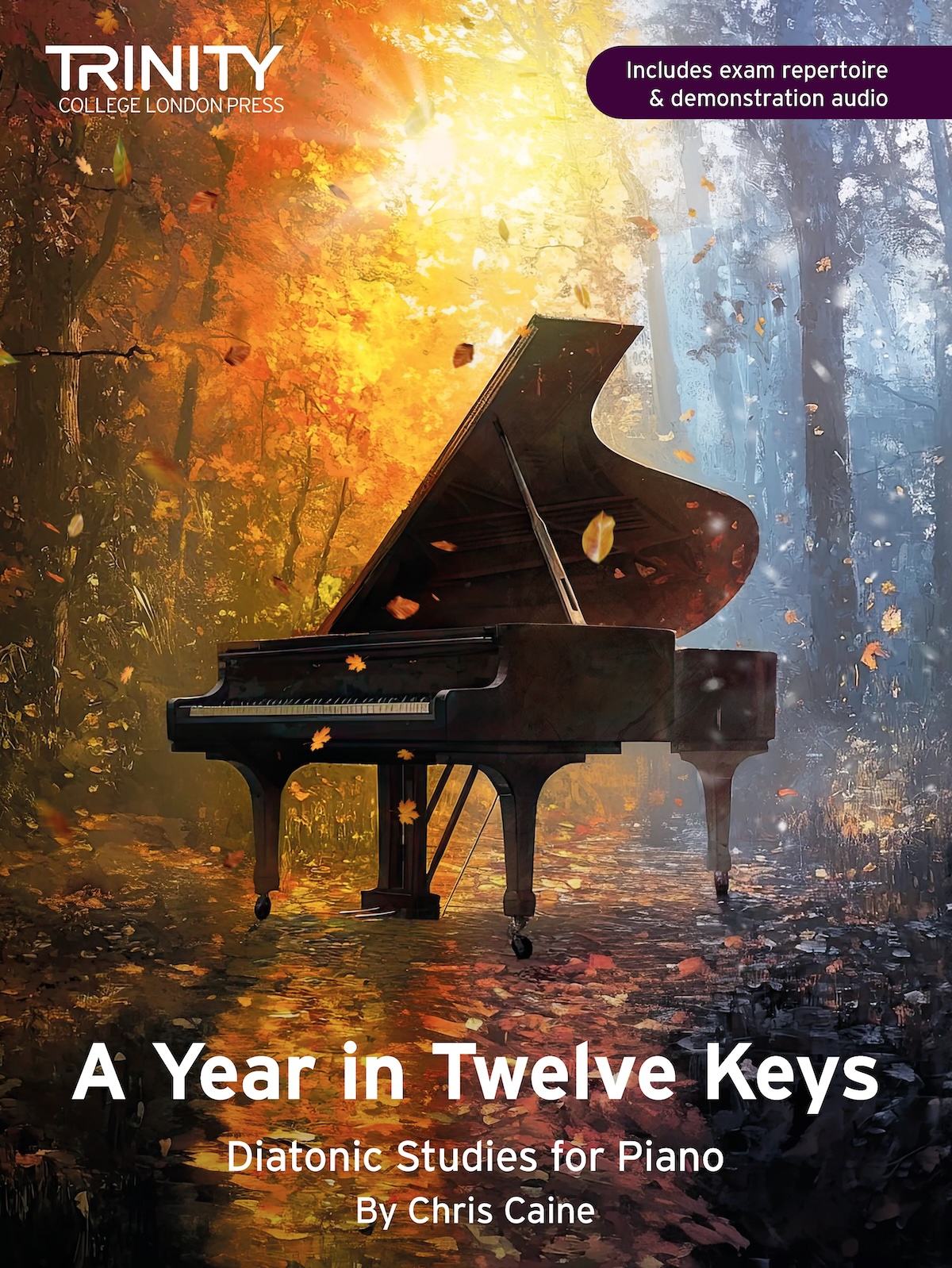
Tristesse (from A Year In Twelve Keys)
Chris Caine Advanced
Digital Download
Sad Prelude
Hans-Günter Heumann Early Intermediate
Digital Download
Music becomes meaningful when it helps us explore something human.
For younger students, the challenge of learning something new might be enough to maintain interest. But eventually they need to figure out that music making is about more than getting it right, more than just doing it correctly.
In this episode, I play two pieces that might help students connect the dots between how we make music and why. “Tristesse” by Chris Caine from his collection “A Year in Twelve Keys”, and then the “Sad Prelude” by Hans-Günter Heumann.
— Transcript —
A large part of a child’s beginning piano studies centers around how. How do we do it? How do we actually make the music?
We start out learning the symbols. We learn how to physically produce the sounds on our instrument. We learn about different musical styles and eventually how tradition shapes our interpretation of the music. That’s the how.
Lately, I’ve become more interested in the why. In our present day, there are so many different activities and distractions competing for our students’ interest. I know a lot of us in the teaching field feel like we’re fighting an uphill battle trying to retain students and keep them motivated and interested.
I think one way we can approach this is to help them make this connection to the why, the why we make music at an early age. Music is about telling the human story in a way that goes beyond what words express. At the heart of this story is our emotional experience.
I’m definitely not suggesting that we take on the role of psychologist by any means. Although I’m sure you also have had lessons where you’ve felt thrust into that role. But at the same time, we don’t have to be shy about sharing how music helps us with our own processing of feelings.
This week, I have two pieces written at two very different levels, both with sadness as a theme. But I don’t think either one of them is going to quite match what you might be expecting.
I’ve got a rather advanced piece from Chris Kane. It’s the September installment from his collection A Year in 12 Keys that we’ve been exploring on the first week of each month. And then I’ll follow that with a simple, sad prelude for early intermediate students from the German composer Hans-Gunther Heumann.
Two sad pieces that can actually leave you feeling pretty okay. Maybe even a little better. Coming up next on the Piano Pedagogy Playlist.
Greetings and welcome. My name is Luke Bartolomeo. I’m a pianist, a teacher, and also a developer of music education apps for children, including Rhythm Swing.
Each Monday on this podcast, I play through some of my current favorites from the piano teacher’s repertoire, written by living composers. This week, sad songs.
The first is called Tristesse. It’s French for sadness, and it’s by Chris Kane. It’s the September piece in his collection A Year in 12 Keys, each of which explores strictly diatonic writing. Each piece remains within its key without chromatic notes or accidentals outside of the key signature.
Now, if you’ve been following along since January, as we’ve been working our way through Chris’s collection, you know that he’s presented us with a wide variety of styles. But there has been one thing the pieces have all had in common. They’re not particularly easy.
And that got me thinking a little bit about our repertoire choices as students become more advanced. In our excitement that we have this student who is now ready for some serious Chopin or Liszt or Rachmaninoff even, it’s almost like the advanced students graduate out of contemporary repertoire.
As if contemporary composers in the realm of piano pedagogy exist to help students prepare for the actual repertoire, most of which comes from the 18th and 19th centuries. And I love that music as much as anyone, don’t get me wrong.
But I think we do students a disservice if we don’t help and encourage them to find classical, in quotes, classical, pieces for the piano that are written by composers who are still shaping the repertoire of the instrument today.
With regards to the piece you’re about to hear, Tristesse, it doesn’t sound like a stereotypical depiction or the soundtrack to a tragic film. It’s maybe a more complex type of sadness. Something that doesn’t exactly know how to express itself.
A sadness that accumulates over time, but finally comes welling up from deep inside. In the form of a series of strong climactic chords that leave us feeling a little more at peace, but also still uncertain at the same time.
September’s piece from A Year in 12 Keys by Chris Kane, here is Tristesse.
At the beginning of this episode, I talked about helping students realize why music making was important and how it could become a meaningful part of their lives.
This next piece, Sad Prelude, gives us an opportunity to just quietly be with our sad feelings. Or maybe remember a time when we were sad, but also notice how the intensity of that particular moment didn’t last forever.
The same way an actor has to explore a variety of emotions and become comfortable with them, so that at any given moment they can express joy even when not feeling especially joyful, or anger when they aren’t really feeling angry.
Musicians have the opportunity to develop their emotional intelligence by learning how to express their feelings in sound. Whether or not those feelings are what they are actually experiencing at the moment. We can remember them as something we felt in the past, and will likely feel again in the future.
And there may be something even more valuable about exploring intense emotions through music when we aren’t actually in the midst of experiencing them. We can more accurately view them and start to understand them from a little bit of a distance.
Similarly to our first piece, the sad prelude isn’t a weepy, heart-on-its-sleeve sort of affair. But it does sound to me like a very genuine expression of how we all feel sometimes. And it’s okay.
The piece is very much a prelude in the Baroque sense, with a satisfying progression through the circle of fifths. But with some major seventh chords thrown in for a more contemporary atmosphere.
It’s just one page, with repeat, a bit of a challenge for an early intermediate student, good sight-reading material for a late intermediate one. And also the opportunity for a quiet moment of reflection for a piano teacher as well.
This is the sad prelude of Hans-Günter Heumann.
Music becomes meaningful when it helps us explore something human. For younger students, the challenge of learning something new might be enough to maintain their interests. But eventually, they need to figure out that music making is about more than getting it right. More than doing it correctly.
Although, yes, they should get it right. But that’s the starting point, not the destination.
Today, I played two pieces that might help students connect the dots between the how we make music and the why. Tristesse by Chris Kane from his collection, A Year in 12 Keys. And then, the sad prelude by Hans-Günter Heumann.
As always, links to purchasing both pieces as an instant digital download are in the episode description, and on the website as well. You can find us at pianopedagogyplaylist.com.
And just like that, we have to close the lid on this episode of the Piano Pedagogy Playlist.
Whenever I have a student who enters the lesson in an obviously sour mood, I gently acknowledge that I see that. And I’ll tell them that we’ll check in at the end of the lesson to see if they’re feeling a little better. Or the same. Or, heaven forbid, worse.
Usually, at the lesson’s end, they have to admit they are feeling a little better. However, music generally has that effect. Even when we’re playing sad songs.
I’ll be back next Monday with some more of what’s good in the contemporary piano teacher’s repertoire. Until then, keep nurturing the music. And have a great week.

Leave a Reply