


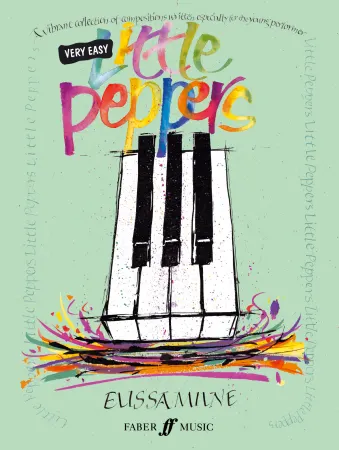
Salt and Pepper (from Very Easy Little Peppers)
Salt and Pepper
Elementary
Digital Download single piece or Entire Collection
Printed Edition
Smooth and Crunchy (from Very Easy Little Peppers)
Elementary
Digital Download single piece or Entire Collection
Printed Edition
Safari (from Very Easy Little Peppers)
Late Elementary
Digital Download single piece or Entire Collection
Printed Edition
Flâneur (from Very Easy Little Peppers)
Elementary
Digital Download single piece or Entire Collection
Printed Edition
Chase (from Very Easy Little Peppers)
Elementary
Digital Download single piece or Entire Collection
Printed Edition
Storm in a Teacup (from Very Easy Little Peppers)
Late Elementary
Digital Download single piece or Entire Collection
Printed Edition
Three Legged Race (from Very Easy Little Peppers)
Late Elementary
Digital Download single piece or Entire Collection
Printed Edition
Method books give us structure and sequence, but they don’t always provide enough reinforcement—or enough variety—to keep students fully engaged. That’s where supplemental repertoire can make a meaningful difference.
In this episode, we explore Very Easy Little Peppers by Elissa Milne—a collection of short, engaging pieces designed for early elementary piano students.
These pieces offer teachers the opportunity to:
- reinforce key concepts
- introduce musical challenges in a manageable way
- highlight each student’s unique strengths
- and bring fresh, appealing repertoire into early lessons
We’ll look at seven selections from the collection, grouped by how they can function in your teaching:
- articulation-focused studies that build control and independence
- simple pieces with a modern, engaging sound
- and slightly more advanced works that can serve as recital-ready showpieces
Whether you’re looking to support a struggling student, challenge a quick learner, or simply add variety to your teaching, this collection offers practical and musical solutions.
— Transcript —
Method books, we love them or we don’t love them. Maybe we tolerate them. They can be very helpful, especially to teachers who are relatively new to this profession.
They give us structure, they give us sequence. They help us make sure that we’re not skipping important steps. But if we overly rely on the method we’ve chosen, even if we do love it, I don’t think we’re giving our students a complete musical diet.
Now, some students are teacher pleasers, and they will dutifully go from page to page in a method, practicing what is assigned, probably making pretty good progress.
But I’ve been hearing more and more about the difficulties of students who become disinterested and won’t practice. There can be a whole host of reasons for that.
But one we should consider is that many of today’s children just don’t see the point in struggling to learn pieces that they’re not that fond of in the first place. This is where supplemental repertoire can, maybe, save the day.
Today, I want to share some music that fits that role beautifully. This week, we’re looking at the collection, Very Easy Little Peppers by Elissa Milne. Now, I’ve talked about her Little Peppers series before.
But this volume is aimed at even younger elementary-level students. Students who have already acquired some skills, to be sure, but who need reinforcement and, quite often, motivation.
I have seven of these short little gems ready to play for you, and they’re coming right up on the Piano Pedagogy Playlist. Greetings and welcome. I hope your day is going well.
My name is Luke Bartolomeo, and I’m a pianist, a teacher, as well as a developer of apps for music education, including Flashnote Derby.
Each Monday, I play for you some of what I’m currently loving in the world of contemporary piano repertoire written for students, all by living composers.
One of the limitations of Method Books is that they do a pretty good job of introducing concepts, but they don’t always reinforce them enough.
Just as an example, a student might learn the various articulations and the symbols to go with, but they’re going to need to experience them in a lot of different ways, and hopefully for a variety of musical purposes, in order for it to really stick.
Supplemental Repertoire gives us the chance to zero in. We can give our students focused repetition, but in a musical context. In other words, actual pieces.
3:07
Articulation Development
Sticking with this theme of articulation, let’s explore how three pieces from this series, Very Easy Little Peppers, could be used in our teaching. The first piece is called Salt and Pepper, and it’s a great starting point.
You’ve got staccato and legato, clearly contrasted, but both hands are doing the same thing at the same time. The student isn’t overwhelmed and can focus on the mechanics, the physical aspects of creating the sound.
Then we take it a step further with smooth and crunchy. One hand is legato, the other hand is staccato, and then they switch. It’s truly a rub your belly, pat your head moment that will probably frustrate them a bit at first.
But the independence of the two hands is something fundamental in lots of different ways for pianists, and we had best start introducing it pretty early on.
The third piece in this set is called Safari, and it takes this skill we’ve been working on and has it serve a musical purpose in a more developed composition. Listen now to these three artistic studies in articulation.
Salt and Pepper, Smooth and Crunchy, and finally Safari. When we step outside of the method books, it can benefit our students, but don’t underestimate the benefit that we as teachers get from constantly seeking out new repertoire.
6:03
Teacher Engagement
We’ll always have our personal tried and true favorites, but teaching new pieces forces us to continually think and can keep us from falling into a rut with our teaching.
We’re going to turn now to two pieces that could be introduced quite early in a child’s studies, possibly taught by rote.
But each piece has a little something special that might make it feel fresh for us to teach and may be a little more appealing to students. The first one has a French title.
It’s called flaneur, which just means someone who wanders about town, observing all the absurdities of daily life. The hands are in middle C position, but the left hand incorporates two black keys into the pattern. That completely changes the flavor.
Instantly, we’ve got something that just sounds a little more with it, even to young ears. That’s followed up by a piece called chase.
When it starts, you’re going to think right away, it sounds like a dozen other pieces that you’ve taught in a similar style.
But the introduction of some humorous dissonances, and one line in particular that has a fuller two-handed texture, make it just a little bit more special. Here are two pieces that are quite easy, but still pretty cool. Flaneur followed by chase.
9:16
Student Strengths
So I talked about how supplemental repertoire can be used to focus on specific skills that a student might need to improve on. But it can also allow us to highlight their strengths. Some students naturally latch on to rhythm.
Others have a great ear for phrasing. Others just love bold, energetic music. Reaching outside of our method repertoire, we can assign pieces that lets those strengths be put on display and enjoyed right away.
The final two pieces today are slightly more difficult and are examples that could play to the strengths of a given student. First we have Storm in a Tea Cup.
It would be great for a student with a strong rhythmic sense, who isn’t afraid of the black keys, and who is good at recognizing patterns, this case in the form of harmonic intervals.
There isn’t a lot of beautiful phrasing required here, but you might have a student whose natural musical tendencies would be well suited to this piece. It could be an easy win for both of you. And then the last piece today will be Three-Legged Race.
This one’s clever. It uses an alternation between 4-4 and 3-4 to give a slightly awkward off-balance feel. Kind of like a Three-Legged Race.
It would be perfectly suited for a student who lights up when something sounds a little quirky or off-beat. And the ending to Three-Legged Race? The first time I heard it, I was like, what?
I think it’s great. Here’s Storm in a teacup and Three-Legged Race. So stepping back, this is really what Supplemental Repertoire gives us.
12:36
Repertoire Benefits
It lets us reinforce skills. It lets us highlight what a student does well. It gives the music that feels engaging and satisfying much earlier in their development.
And it keeps us as teachers interested and engaged too. Method books give us a roadmap, but pieces like these let us take the scenic route. And as the saying goes, getting there is half the fun.
If you’re looking for something to add alongside your method books this week, Very Easy Little Peppers by Elissa Milne is definitely worth checking out.
All of the pieces in this collection are available as individual digital downloads, and the entire collection is also available for Kindle or in print.
Links to all the possible ways you can get your students playing some of these pieces can be found in the episode description or by visiting us at pianopedagogyplaylist.com.
And if you want to stay up to date about future episodes of this podcast, make sure to sign up for our unobtrusive, unannoying newsletter while you’re there.
And just like that, it’s time to close the lid on today’s episode of the Piano Pedagogy Playlist. This week, I know I’m going to make a special effort, not so much to teach the page that’s in front of me, but rather the student that’s in front of me.
I’ll look forward to seeing you again next Monday when I’ll share some more of my current favorites from the contemporary piano teacher’s repertoire. Until then, keep nurturing the music! And have a great week!

Leave a Reply