


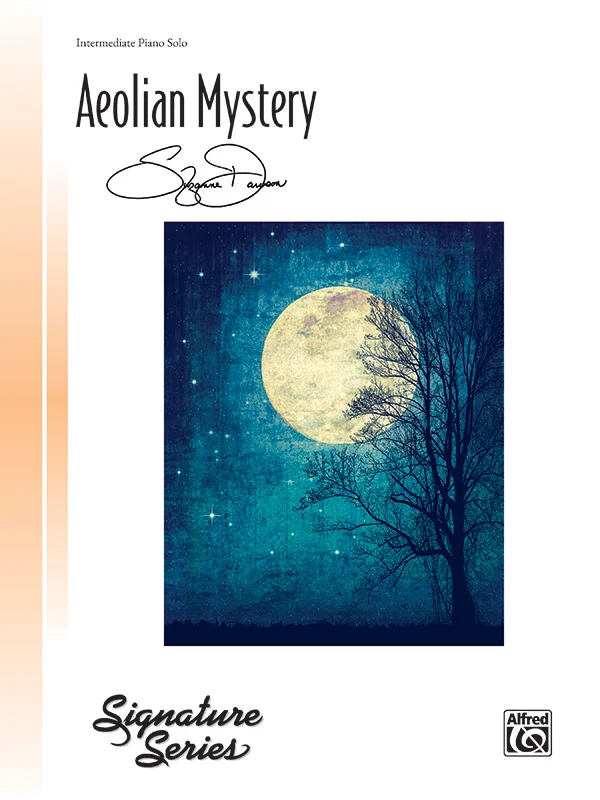
Aeolian Mystery
Suzanne Dawson Intermediate
Digital Download
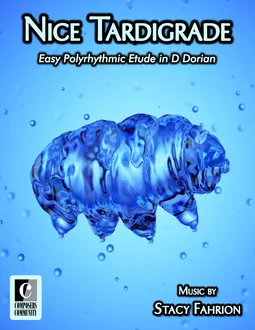
Nice Tardigrade
Stacy Fahrion Elementary
Digital Download
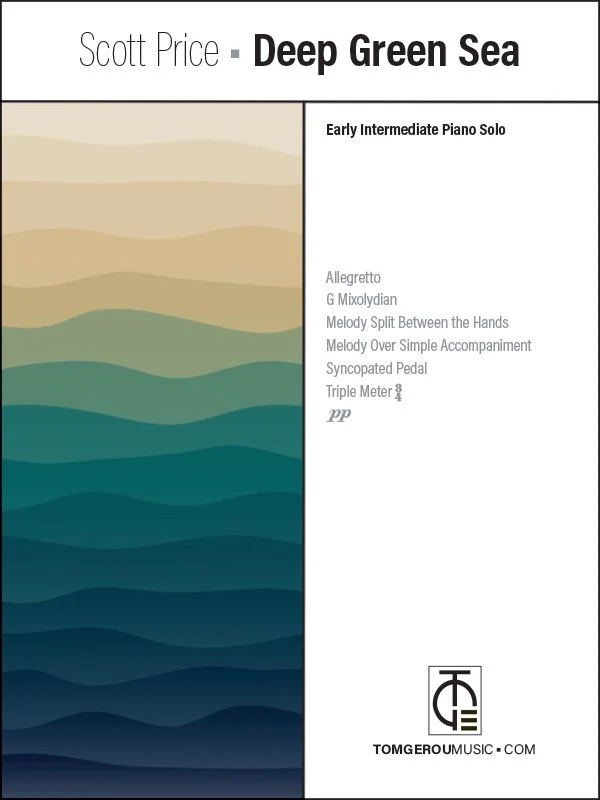
Deep Green Sea
Scott Price Early Intermediate
Digital Download
Printed Edition
Major and minor scales are the foundation of Western music- but what happens when you step outside them? On this episode, I explore three pieces by Suzanne Dawson, Stacy Fahrion, and Scott Price, that use modal sounds to create distinctive musical colors. Each selection also offers a particular teaching focus, connecting its musical character with a practical skill students can develop at the piano. One of the pieces is about a tardigrade. 😳
— Transcript —
The system of major and minor scales, and the chords we derive from them. It’s the foundation of much of Western music. Not just classical music, but all genres and styles. We spend a lot of time helping our students find their way around those 24 keys. And the sounds of them are very familiar, even way before we learn about key signatures and all of that.
Today, however, I’m playing some pieces that don’t quite behave the way we expect. We’re going back to a system of organizing notes that predates the ideas of major and minor. We’re going back to the modes.
In three pieces by Suzanne Dawson, Stacey Farian, and Scott Price, we’ll hear how composers use modal sounds to give their music a distinctive personality. And we’ll consider a few ways to help students hear what makes each one different. A little more proof that everything old is new again. Coming up next on the Piano Pedagogy Playlist.
Greetings and welcome. I hope you’ve been having a good day so far. My name is Luke Bartolomeo. I’m a pianist, a teacher, and also a developer of music education apps, including Rhythm Swing. I’m happy to be with you each Monday on this podcast, where I play through some of my current favorites from the piano teacher’s repertoire, written by living composers.
Today, we’re exploring three of the seven modes, sometimes referred to as the church modes due to their use in Gregorian chant. They have rather imposing names, Ionian, Dorian, Phrygian, Lydian, Mixolydian, Aeolian, and Locrian. But each one is simply a distinct pattern of half steps and whole steps that get you from a point in one octave to the next.
Two of them are already very familiar. Ionian has the same pattern as a major scale. Aeolian is the same as the natural minor scale. And Aeolian is the mode that Susan Dawson uses in the first piece we’ll hear today, Aeolian Mystery.
For me personally, it’s easiest to think of modes in terms of how they differ from a major scale. Aeolian flats the third, sixth, and seventh degrees of a major scale. Or if you prefer, it’s the same pattern of steps that you find in a natural minor scale.
Because of this, it is probably the most traditional sounding of our three pieces today. But there’s one big difference, and that is the lack of a leading tone. The flatted seventh in Aeolian means we don’t have a T in our melodies that points to a tonal center. Without a leading tone, we can’t have a true dominant chord. So no strong dominant tonic cadences.
It makes for a gentler, more open kind of harmonic movement. We can still hear where home is, but the music has a little more freedom to linger along the way. In Dawson’s piece, that helps create the quiet sense of mystery suggested by the title.
And there’s another element of unpredictability and mystery in the rhythm. We have a lilting 6-8 pulse, but the melody often anticipates the beat, slightly shifting our perception of where the pulse actually lies. It fits well with the meandering movement of the harmony. I hope you enjoy Suzanne Dawson’s piece, Aeolian Mystery.
That, I think, could be a good piece for a student at the intermediate level who has smaller hands. The largest harmonic reach is only a sixth. And the pattern that the left hand plays, the familiar root, fifth, and octave, would be good practice at not reaching, but using sideways lateral movement to make sure fingers and thumb line up parallel to each key as it is played.
From Aeolian, we move to Dorian, with a piece by Stacey Farian, called Nice Tardigrade. Tardigrade.
Now, before you think I’ve made a mistake and this piece was actually meant for last week’s podcast about the jabberwock, A tardigrade is actually a real thing. It’s a microscopic, eight-legged animal. It’s sometimes called a water bear. And when you look at one under a microscope, they manage to look both icky and a little bit cute, I have to say, at the same time.
It might seem like a rather unusual subject for a piece of piano music, but in this case, the title, or at least the rhythm of the title, has a very practical purpose.
You see, this piece is really a beginning exercise in two-against-three playing, playing two evenly spaced notes in one hand in the same time as three evenly spaced notes in the other. Almost every measure uses this same rhythmic pattern. And the words Nice Tardigrade can help us remember the sound of the two parts fitting together.
I’m going to tap my right hand and snap my left to demonstrate. Nice Tardigrade. Nice Tardigrade. Nice Tardigrade.
You may already use a similar phrase for this type of rhythm, such as not very hard or maybe not difficult. Or in this particular case, both right-left-right.
The words give students something they can imitate while they work towards eventually feeling and hearing each hand’s rhythm independently. And if you show them a picture of a Tardigrade, you’re sure to get them a little more emotionally invested in the process.
This elementary level study has a methodical, hypnotic character. The texture is wide open, and the repeating pattern gives us time to settle into its gentle motion and enjoy the sound of the Dorian mode, which again is quite similar to natural minor, but this time with a major sixth instead of a minor sixth.
Here’s the piece Nice Tardigrade by Stacey Farian.
Our last piece also seems to have a particular pianistic challenge as its focus. In Scott Price’s Deep Green Sea, the accompaniment pattern you will hear is split across both hands, leaving the right-hand fifth finger to play all of the melody notes.
Shaping a beautiful melodic line with that one finger takes some care, especially when the other fingers are busy with the accompaniment. We need to balance the sounds and connect each melody note to the next, giving the phrase a sense of direction. It’s something we encounter frequently in more advanced repertoire, and this piece gives students an early opportunity to begin developing that control.
As for the mode, this one comes with a slight qualification. The Mixolydian mode has the same pattern as a major scale, except for a lowered seventh degree. In G Mixolydian, that means that we have F natural instead of F sharp. Once again, we lose the leading tone and the familiar pull of a major dominant chord resolving to the tonic.
But Price also makes frequent use of E flat in this piece, which is the lowered sixth degree. It appears in both the accompaniment and the melody, and it’s included in the scale that closes the piece.
That pattern belongs to a larger family of modes derived from melodic minor. But that’s a topic for another episode. Or maybe not.
But it does give us something interesting to take note of. Composers can write a piece in a certain mode and still include notes from outside of it, just as a piece in C major can include chromatic notes. Here, the recurring E flat is an important part of the piece’s identity, even though it is technically from outside of the mode the piece is written in.
Here is Scott Price’s Deep Green C, an early intermediate piece that gives the right-hand fifth finger a chance to sing.
We started today talking about modes, but along the way we found three pieces with very practical things to work on, moving comfortably through broken left-hand patterns, coordinating two against three, and shaping a beautiful melody with our littlest finger.
Each composer gives their particular challenge a musical purpose. Combine that with the distinctive colors of the modes, and students have something fresh and modern to work on as they develop those skills.
As always, links to purchasing the individual pieces featured in this episode can be found in the description, and on our website as well, pianopedagogyplaylist.com.
And just like that, it’s time to close the lid on this episode of the Piano Pedagogy Playlist.
One thing I like about exploring modes is how much difference a single note can make. Raising a fourth or lowering a seventh can change the character of a whole piece. So the next time you have a student plow through a piece for getting all of the F sharps, just tell them that was some great improvised exploration in G. Mixolydian.
I’ll be back next Monday with some more of what’s good in the contemporary piano teacher’s repertoire. Until then, keep nurturing the music, and have a great week.

Leave a Reply