

Les vagues berceuses (from Piano au bord de l’eau)
Marina Alcolea Elementary
Digital Download
Le chant de l’eau (from Piano au bord de l’eau)
Marina Alcolea Elementary
Digital Download
Lac miroir (from Piano au bord de l’eau)
Marina Alcolea Early Intermediate
Digital Download
Gare sous la pluie (from Piano au bord de l’eau)
Marina Alcolea Intermediate
Digital Download
Néréides (from Piano au bord de l’eau)
Marina Alcolea Late Intermediate
Digital Download
Students often fall in love with pieces like Clair de lune long before they have the technique to play them well.
And as teachers, that puts us in a tricky spot.
We don’t want to dampen that enthusiasm—but we also know those pieces are, at the moment, out of reach. And handing them a simplified version rarely captures what drew them in to begin with.
In this episode, I explore a collection that offers a better solution.
Marina Alcolea’s Piano au bord de l’eau introduces students to the sound world of French Impressionism through music that is approachable, pattern-based, and genuinely musical—without feeling like a watered-down version of Debussy.
If you’re looking for repertoire that meets students where they are—while still honoring the music they’re drawn to—this is a collection worth exploring.
— Transcript —
I love French Impressionism. I played as much of it as I could in college, and I still enjoy playing it today. I love Ravel, I love Debussy, and some of my students love Debussy too.
And that can actually be a problem, because students will fall in love with pieces like Claire de Lune or the first arabesque years before they have the technique, the control, the tone, the pedaling, everything those pieces require to sound the way
they’re meant to. When that happens, I feel torn, because I love the fact that they’re excited about this new music they’ve recently discovered.
And I don’t want to dampen their enthusiasm, but I know they’re not ready for the original, and I don’t really want to give them some kind of watered down arrangement.
What they’re responding to isn’t just the specific piece, it’s the unique and exciting sound world in which Impressionism dwells. So what do you give a student who wants that, but isn’t ready for the real thing?
Today’s music might be one of the best answers I’ve come across. And I’m playing it for you next on the Piano Pedagogy Playlist. Greetings and welcome.
I hope your day is going well. My name is Luke Bartolomeo. I’m a pianist, a teacher, and also a developer of music education apps, including Flashnote Derby.
Each Monday on the Piano Pedagogy Playlist, we explore teaching repertoire that is practical, engaging, and musically meaningful. All of it written by living composers.
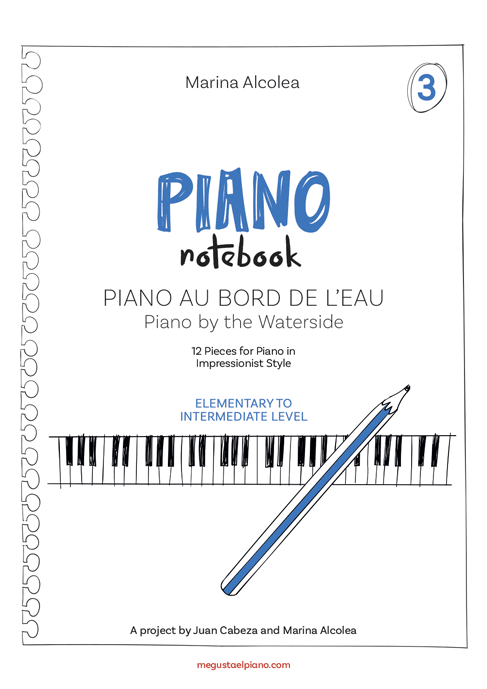
Today’s episode features music by Marina Alcolea from her collection, Piano au bord de l’eau, Piano by the Waterside.
1:57
Alcoleaʼs Water Music
Marina Alcolea is a Spanish pianist, teacher, and composer. She’s now based in France, so it’s not really surprising that she would be inspired to create a volume of student compositions that draw on the style of French Impressionism.
This collection is part of a larger project called Piano Notebook, and it’s available on the website Me gusta el Piano, a blog full of pedagogical resources for elementary and intermediate students. The volume we’re looking at today, Notebook No.
3, Piano by the Waterside, is centered around very specific ideas. Water, reflection, and symmetry. If you have a student who is drawn to the style of Debussy and Ravel, this collection can be an accessible bridge into that sound world.
And let’s start with two pieces that introduce that sound world in the most direct, accessible way. The first piece is titled Les Vagues Berceuses, Swaying Waves. Now, nothing says impressionism like the whole tone scale.
And that’s basically what this first piece is. An introduction to the two variants of the whole tone scale. It exists, of course, in the form C, D, E, F sharp, G sharp, A sharp, or D flat, E flat, F, G, A, B.
And both of these permutations are presented here. It’s a piece you can teach by rote, and right away, students get that unmistakable, floating, impressionistic color.
The second piece takes that same sound world and gives us a haunting melody to sing in it. It’s called Le chant de l’eau, the water’s song. And now, instead of just exploring color, we’re shaping a lyrical line using those colors.
Here is Swaying Waves, followed by The Water’s Song.
6:50
Mirror Symmetry Exploration
In addition to impressionism, one of the core ideas of this volume is something that is obviously very dear to Miss Alcolea. And that’s something is called mirror symmetry. The idea is this, our bodies are symmetrical, more or less.
Our hands are symmetrical, and the piano keyboard can also be symmetrical. If you draw an axis line through the D key, or through A flat. Once you do that, the patterns of white and black keys on either side are a perfect mirror image of each other.
Miss Alcolea explores what happens when we exploit this symmetry. And intervals are mirrored around a central axis.
In this collection, she even uses something called inverted notation, where accidentals are written as sharps in one hand and flats in the other hand.
Not so you actually try to read both staves at once, but so you understand the symmetry and the relationship between them. But what I find especially interesting is why she uses this.
She points out that symmetrical movements are among the most natural movements our bodies can make. And by working this way at the piano, it can help students develop coordination more naturally. The more dominant hand can help guide the other.
It builds a kind of balanced technical foundation. So it’s not just a compositional gimmick, it’s a pedagogical tool. In this next piece, Lac, Miroir, you hear this idea in action.
The piece is built around symmetry. Sometimes the hands are exploring that symmetry together in contrary motion. Other times they are exploring symmetrical patterns, but more independently.
Now all of this sounds pretty technical, but I think you’ll be able to hear these concepts in action. You can definitely feel them when you play the piece. Here is Lac, Miroir, Mirror Lake.
If you’re intrigued by this idea of mirror symmetry, the composer lays it all out for you, with pictures even, in the preface to this collection. It’s quite interesting.
10:32
Debussy-Inspired Pieces
Finally, we arrive at two pieces in particular for that Debussy hungry student I’ve been talking about. Debussy, of course, wrote a famous piece called Jardin sous la pluie from The Sweet Estampes, Gardens in the Rain.
The first piece in this pair is called Gare sous la pluie, Train station in the rain. And whereas Debussy’s piece is over three minutes long and is a technical tour de force, Alcolea’s piece is about 30 seconds in length.
And it’s fairly easily learned, but it will still provide the opportunity for technical development for students at the level you’d be assigning this to.
And then finally, I’ll end with the piece I would reach for when a student says, I want to play Claire de Lune. The title is Néréides, and it refers to sea nymphs, figures from Greek mythology associated with the ocean.
And the music really captures that image. There’s a flowing, sinuous melody set over an accompaniment that gently rocks like waves on the ocean. It’s certainly not an easy piece.
But for a student who is even considering playing something at the level of Claire de Lune, it should definitely fall into the category of realistically doable. My final two offerings by Marina Alcolea, Train Station in the Rain, and then Néréides.
Today, we’ve looked at five pieces from Piano au bord de l’eau by Marina Alcolea. It’s a collection featuring sophisticated impressionistic sound and genuinely musical expressive writing in pieces that are approachable for students.
The book itself is also beautifully put together with simple line art illustrations, a cohesive aesthetic, ample notes from the composer, and even a thoughtful glossary of French musical terms.
It feels like a thoughtfully designed teaching resource, not just a collection of pieces. If you’d like to explore the full collection, look for the link to where you can purchase a digital download in the episode description.
The book is priced appropriately for a quality collection of a dozen pieces, but it includes a studio license, so you can print out as many copies as you like for your students, with the publisher’s blessing.
You’ll also find links to today’s music, as well as all the music featured on the podcast on our website, pianopedagogyplaylist.com. And just like that, we have to close the lid on today’s episode of the Piano Pedagogy Playlist.
In putting together this episode, I was really reminded that when a student falls in love with a piece, that instinct is worth protecting, even if the timing isn’t quite right.
Sometimes our job is simply to find the right stepping stone that keeps that enthusiasm alive. I’ll look forward to seeing you again next Monday when I’ll share some more of my current favorites from the contemporary piano teacher’s repertoire.
Until then, keep nurturing the music and have a great week.

Leave a Reply