


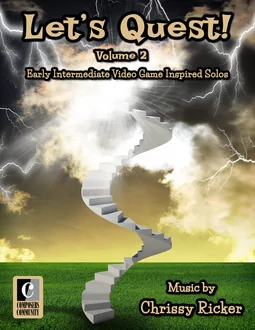
Mission Alpha (from Let’s Quest, Vol. 2)
Chrissy Ricker Early Intermediate
Digital Download
Printed Edition
Only in Dreams (from Let’s Quest, Vol. 2)
Chrissy Ricker Early Intermediate
Digital Download
Printed Edition
Stealth Mode (from Let’s Quest, Vol. 2)
Chrissy Ricker Early Intermediate
Digital Download
Printed Edition
Awakening (from Let’s Quest, Vol. 2)
Chrissy Ricker Early Intermediate
Digital Download
Printed Edition
Today’s episode is for a very specific student.
The one who’s deeply immersed in video games and gaming culture… who loves music—but doesn’t think they love piano. Maybe they’ve even decided they’re a little too cool for it.
This week I’m sharing music that can change that perception.
Featuring selections from Let’s Quest, Volume 2 by Chrissy Ricker, these original piano pieces capture the sound world of video games.
Even though the music is new, it feels familiar—often leading students to that moment of recognition:
“Oh… this feels like my music.”
In the episode, I share a recent teaching moment where that exact shift happened—and how repertoire like this can completely change a student’s outlook on their piano studies.
— Transcript —
Today’s episode is for a very specific student. One who is deeply engrossed in video games and the whole gaming culture. They might really love music, their music, but they don’t think they love piano.
Maybe they think they’re a little too cool for it. This week, I’m sharing music from the Quest series by Chrissy Ricker, specifically, Let’s Quest, Vol. 2.
These are original piano pieces that sound like they could be right at home in a video game soundtrack. What makes them so intriguing isn’t just the style.
These pieces get an immediate reaction and can make a student say, oh, this feels like my music. When that happens, the way they view the piano can start to change. We’re stepping into the gamer’s world coming up on the Piano Pedagogy Playlist.
Greetings and welcome. I hope your day is going well. My name’s Luke Bartolomeo.
I’m a pianist, a teacher, and also a developer of music education apps, including Flashnote Derby. Each Monday on the Piano Pedagogy Playlist, we explore teaching repertoire that is practical, engaging and meaningful.
All of it written by living composers. This week, we’re tapping into something that many of our students are very passionate about. The four pieces I’m playing feel like they come from, I don’t know, somewhere else.
But it’s a world these students readily recognize. They’re all from Chrissy Ricker’s collection, Let’s Quest. And today I’m featuring Volume 2 for students at the early intermediate level.
2:07
Mission Alpha Analysis
We’ll start with a piece called Mission Alpha. Suitably, it starts out with a zero gravity section that just kind of floats aimlessly in anticipation. The main melody that follows is surprisingly jaunty and upbeat.
It’s classic pattern and sequence, so you can sneak in some info on compositional devices and explain how even video game music composers rely on some of the same techniques used by the classical masters. I really enjoy the melody.
It does make me think of a looping soundtrack to a role-playing adventure game, particularly the carefree moments of exploring, where there aren’t any immediate threats to deal with. Here’s Mission Alpha.
Did your ears pick up on how that piece actually ended on the dominant? Although it kind of felt like it became the tonic because of the drawn out arpeggio leading up to it.
Video game music is often a never ending loop, so arrangements often have to come up with some kind of way to stop. And several of these pieces by Chrissy Ricker employ some rather creative and unexpected ways to do that.
5:12
Only in Dreams
Turning now from the world of outer space to the inner subconscious, we’ll hear a selection called Only in Dreams. To my ears, this is the least gamey sounding piece of today’s set, but regardless, there’s still a lot to like here.
It starts out peacefully, as if we’re drifting off to sleep. That fades into a gentle lyrical section that eventually gives way to a soaring melodic outburst, as if the dream suddenly zigzags into an unexpected place, as they often do.
It ends as it started. Maybe we’re slowly waking up and trying to recapture what it was that we saw and experienced in our dream. Here is Only in Dreams.
7:40
Stealth Mode Exploration
After two rather abstract pieces, our third piece has a very clear concept. It’s called Stealth Mode.
Now, in role-playing adventure games, Stealth Mode could refer to some kind of power-up or spell that allows you to move about undetected by enemies.
But there’s also a kind of uneasiness, because you can never be sure exactly when the spell will wear off, or maybe the bad guys are immune to its effects and you’re setting yourself up to be captured.
The music conveys this quiet intensity really well. The left hand is doing all the heavy lifting with a continuous pattern of eighth notes, and the right hand just provides an occasional harmonic punch.
The dynamic level starts out piano, so you have to manage this intensity and keep it controlled. It’s giving off serious hide-and-seek energy. Your heart’s racing, hoping you’re not about to get caught, but you have to remain completely calm.
For all of these pieces today, you could have a blast letting your student take the lead in creating stories to accompany what the music is doing.
Maybe we start to win over the skeptic this way, when they see that the piano too can be an effective storyteller and a way to escape into a distant world. Buckle up for Stealth Mode by Chrissy Ricker. And this time, we end on the leading tone.
Hey, why not? It sets us up perfectly to repeat it all over again. That was Chrissy Ricker’s Stealth Mode.
10:54
Student Connection
So just this week, I had a student where I could tell from the get-go it was not going to be a very productive lesson.
Rather than force the issue, and since I knew he was really into video games, and I had been playing through this collection, I thought I would take some of the lesson time to get his opinion.
So I briefly described the concept of the book, video game-inspired music, not actually taken from games, but trying to capture their style and emotion. I played through a section or so of each piece, and waited for his assessment.
Every single piece got a thumbs up, and there were several that I could tell were really appealing to him. Even though it wasn’t the actual music he knew from games that he played, it felt to him like his music.
It was relatable, and it changed the trajectory of the lesson for the better. The final piece on offer today, it’s an epic adventure.
It’s in ternary form, and the way I imagine it is the initial A section is a preparation, getting ready for the intense battle of the B section. That brings us back to the A section and the battle’s aftermath. Our final piece today, Awakening.
14:17
Finding Student Music
Now, I don’t know what you were like as a piano student, but I was pretty agreeable to study the pieces that my teacher assigned me. There wasn’t really the opportunity to say, I don’t like this piece, this is boring, I’m more interested in whatever.
Obviously, that’s not how it works anymore. And I think that’s largely for the better. Students need to find their music, the music that doesn’t require us to explain to them why it’s good, or convince them that it’s worth practicing.
And sometimes, once they find that musical experience at the piano, it can unlock their willingness to take a chance on some other repertoire we might suggest.
We earn some serious cred in the eyes of our students when we show willingness to meet them where they are. And, hopefully, they’ll be willing to follow us into some places they wouldn’t normally venture. Kind of like a quest.
Let’s Quest, Volume 2 by Chrissy Ricker is available from Piano Pronto in both printed and digital versions.
There are five books in all in the Let’s Quest series, and you can find links to purchasing them in the episode description or by visiting our website pianopedagogyplaylist.com.
If you stop by to see us, be sure to sign up for our non-obnoxious, non-intrusive newsletter that will simply inform you whenever new episodes of the podcast are released.
And just like that, the final boss is down, the loot has been collected, and it’s time to save our progress and exit this episode of the Piano Pedagogy Playlist.
May all of us be on a quest this week to find music that makes our students feel like they belong at the piano.
I’ll look forward to seeing you again next Monday when I’ll share some more of my current favorites from the contemporary piano teacher’s repertoire. Until then, keep nurturing the music, and have a great week.
Leave a Reply