


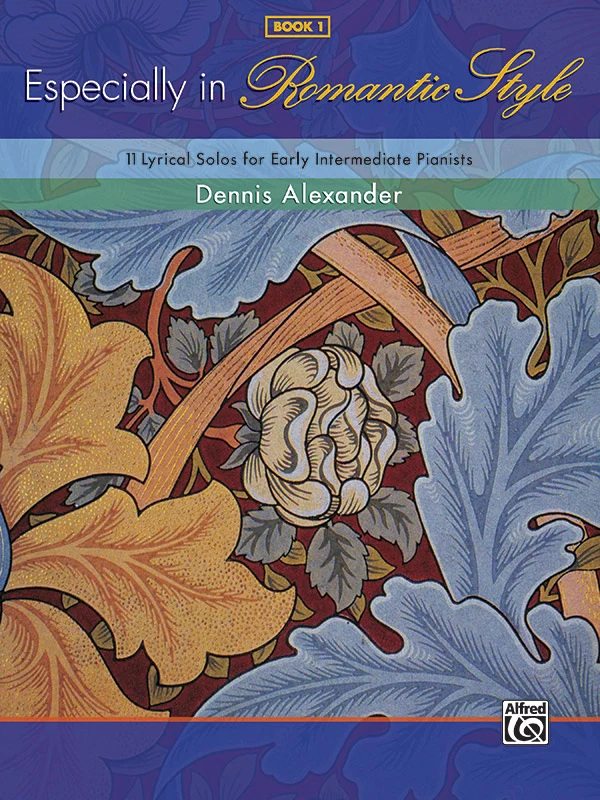
Gentle Breezes (from Especially in Romantic Style, book 1)
Dennis Alexander Early Intermediate
Digital Download
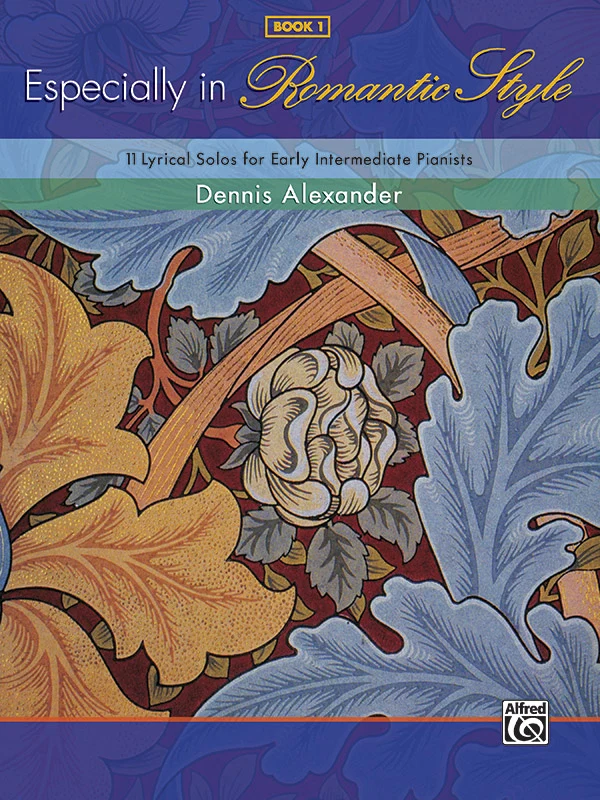
Sweet Jasmine (from Especially in Romantic Style, book 1)
Dennis Alexander Late Elementary
Digital Download
Getting something right once is not the same thing as making it a habit. In this episode, I explore how fundamental skills become musical reflexes through two pieces by Dennis Alexander: Gentle Breezes and Sweet Jasmine.
First, getting students to listen for the balance between a singing left-hand melody and understated right-hand chords in Gentle Breezes (early intermediate). Then, in the simpler Sweet Jasmine (Late Elementary), hear how subtle phrasing gives even elementary music direction and meaning. Along the way, I reflect on the struggle of remaining patient while holding firm to musical expectations and how the simplest, ordinary habits lead to extraordinary playing.
— Transcript —
One of the easiest mistakes to make as a teacher is to confuse a skill that has been demonstrated successfully once or twice with one that has been ingrained and is now second nature.
Let me explain. I’m working with a student on voicing, and they can explain the concept. They’ve acquired the coordination and the control to physically be able to do it. The melodic line is clear and in charge. The accompaniment is supporting, staying in its place. But then a week or two later, they start a new piece that also has some of the same things going on, same voicing skills required, only now the accompaniment chords are blasting out on every beat and the melody drowns in a sea of overtones.
The more years that I’m doing this, the more I’m convinced that extraordinary playing isn’t so much about doing the extraordinary things, but it’s about doing the ordinary basic things so consistently that the playing becomes extraordinary.
The pieces I’m playing today are by Dennis Alexander, a composer I featured before on the podcast, and I’m sure many of you already know his music well. Alexander has described himself as a hopeless romantic. And I’ve chosen two beauties from his collection, especially in romantic style, each providing an opportunity to focus on a fundamental skill. They are coming up next on the Piano Pedagogy Playlist.
Greetings and welcome. I hope your day is going well. My name is Luke Bartolomeo. I’m a pianist, a teacher, and also a developer of music education apps, including Rhythm Swing, which has an exciting update arriving soon that I’ll be sharing with you. Each Monday on this podcast, I play through some of my current favorites from the Piano Teacher’s repertoire, all written by living composers.
The two pieces I’m playing today are both from book one of the collection, especially in romantic style. Even though they’re in the same book, the Royal Conservatory syllabus puts them a couple of grade levels apart. I’m going to start with the early intermediate level three piece, and then actually work back to the late elementary level one piece, so that we can see how foundations are laid at the earliest stages for future success.
Our first selection is called Gentle Breezes. And in this case, gentle does not mean bland. It’s a lyrical waltz in D minor with lots of chromatic color. Both hands get the chance to carry the melody, and it’s those moments when the left hand is leading that the right hand gets the chance to show what a good supporting player it can be.
And yet, students will land on those chords with such force and give them all the importance as if they were the stars of the show. So, as a teacher, we take a deep breath and remind them again and again. We’re patient because we know it’s a process, but we don’t give up either. We understand that these skills today, that require a lot of conscious effort, need to be developed into musical reflexes, just part of who we are as a musician. I hope you find my voicing acceptable. This is Dennis Alexander’s lovely and satisfying Gentle Breezes.
Now, on to an easier, late elementary level piece. It shares much of the musical character we just heard. It’s called Sweet Jasmine. And it also features a lyrical melody with attractive and occasionally surprising harmonies. But it also removes some of the complications.
The texture is thinner. The issue of voicing isn’t as much of a concern. That simplicity allows us to focus almost exclusively on phrasing. Every phrase has direction. It gathers energy, reaches a point of arrival, and releases. It accomplishes that through subtle changes in volume and timing.
This style of music requires an intense desire to express the meaning of each phrase. It doesn’t have to be overdone, but it must be done. And we focus on that skill independently now in this piece, so that in a year or two, when we’re ready for gentle breezes, we’ve got a little more going on, a little more to manage, our ear is naturally going to be guiding our fingers to sing. Here is Sweet Jasmine.
It isn’t about doing the extraordinary things, but it’s about doing the ordinary, basic things, so consistently that it pains you to hear music played any other way. We heard two pieces from a man who has given and continues to give so much to his fellow teachers and all of our students.
Thank you, Dennis Alexander, for these two gems, Gentle Breezes and Sweet Jasmine, both from book one of the series, especially in romantic style. As always, links to purchasing today’s pieces for immediate download are in the episode description and on the website as well. It’s pianopedagogyplaylist.com. You can buy either piece individually or pony up just a few more dollars and get all 11 selections in the volume.
If you made it this far in the episode, you must have heard something that you liked. So if you haven’t subscribed yet, you can do so on Apple Podcasts, Spotify, YouTube, or wherever you get your podcasts. There’s more good music to get into every Monday morning.
And just like that, we have to close the lid on this episode of the Piano Pedagogy Playlist. The English writer Samuel Johnson said, “People need to be reminded more often than they need to be instructed.” That sounds very much like our job description. Our students do need lots of instruction. They need to encounter new ideas and acquire new skills. But all of this that they learn, we can’t allow them to forget to use it.
I’ll be back next Monday with some more of what’s good in the contemporary piano teacher’s repertoire. Until then, keep nurturing the music and have a great week.

Leave a Reply