



Moonlit Cactus
Amy Ferguson Intermediate
Digital Download
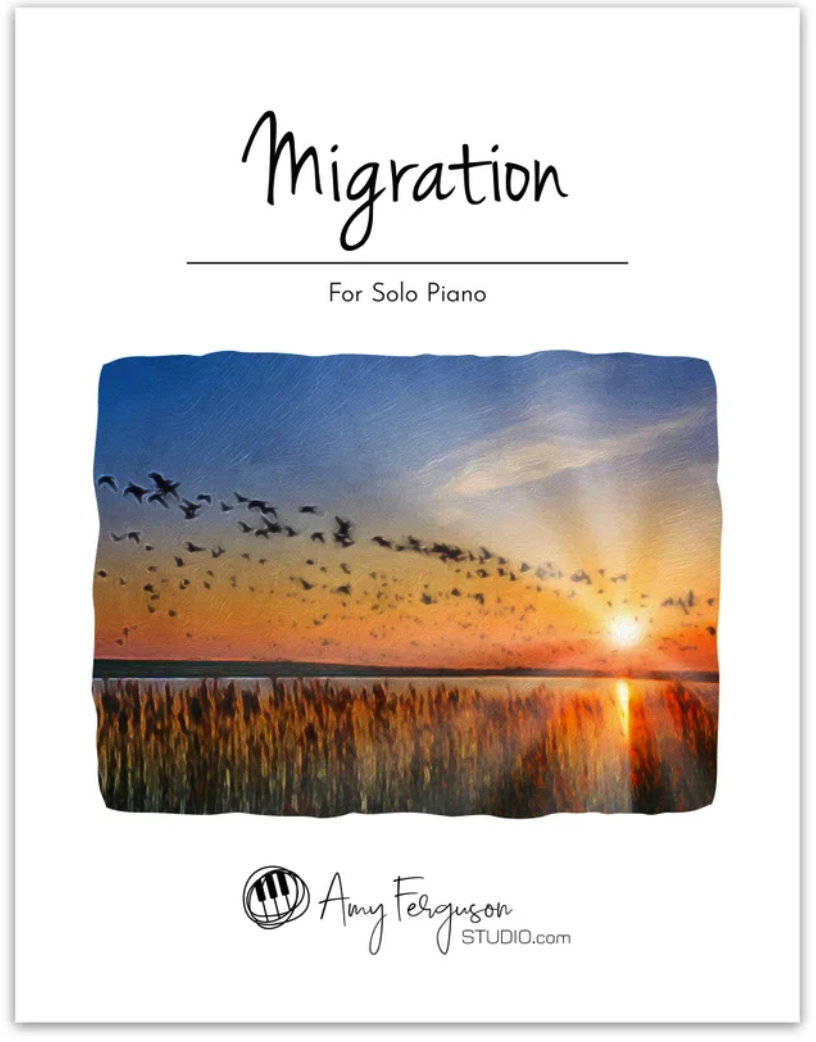
Migration
Amy Ferguson Late Elementary
Digital Download
This week, I present music of Amy Ferguson, a pianist, teacher, composer, and arranger whose self-published pieces grow from the practical needs of her own studio. Ferguson recently received wider recognition when her piece Relámpago won the 2026 Pianist magazine composing competition.
I perform two contrasting solos: Moonlit Cactus, with its cool-jazz harmonies, two-handed syncopation, and opportunities for creative pedaling and sound exploration; and Migration, a peaceful C Mixolydian depiction of birds in flight.
I’ll also give some observations on recording as a tool for honest musical evaluation, and using easier repertoire to help students develop good sight-reading habits.
If you make it to the end of the episode, you’ll hear how it all ties in to an oscure 80s pop song…
— Transcript —
I discovered Amy Ferguson’s website last year, but I ran out of episodes before I could feature her in Season 1. At the time, she seemed to be flying almost entirely under the radar. At least my radar.
Since then, she has won the 2026 Pianist Magazine Composition Competition with a piece called Relámpago. So maybe her under-the-radar phase has already ended. Ferguson has been teaching piano for roughly three decades. And like most of the composers featured on this podcast, most of her composing has grown directly out of her own studio. If she can’t find just the right piece for a particular student or for one of her themed recitals, she writes one.
We’ll hear two of her compositions today that clearly demonstrate that practical connection between composing and teaching. One piece will take us into a moonlit desert where both hands have to navigate simultaneous syncopation. The other tranquilly depicts birds in flight. And gave me a useful reminder that teachers can benefit from recording and evaluating their own playing just as much as students can.
All of this, and if you make it to the very end, how it all connects with an obscure 80s pop song. Coming up next on the Piano Pedagogy Playlist.
Greetings and welcome. I hope your day is going well so far. My name is Luke Bartolomeo. I’m a pianist, a teacher, and also a developer of music education apps for children, including Flash Note Derby and Rhythm Swing. Each Monday, I play through a couple of my current favorites from the Piano Teacher’s repertoire, written by living composers. Today, I’m featuring Amy Ferguson for the first time with two of her self-published piano solos, Moonlit Cactus and Migration.
Let’s begin In the Desert After Dark. Ferguson describes Moonlit Cactus as a contemporary piano solo blending cool jazz with a relaxed and sophisticated atmosphere. The syncopations here involve both hands simultaneously. Neither hand is clearly marking time for the other to play against.
When that happens, the pulse has to live inside the performer. The beat has to be strongly felt even when there are no notes, no sound events representing it. Otherwise, the rhythm becomes wobbly, and the relaxed sophistication of the music begins to sound merely uncertain.
The pedaling here gives the player a certain degree of freedom. Ferguson requests that certain passages should be played without pedal, but elsewhere there’s room for interpretation. A player might use more pedal to emphasize the nocturnal atmosphere and the smoothness of the harmonies. Or the same passage could be played more cleanly and rhythmically, emphasizing its jazz character.
I like when composers don’t aggressively specify every single detail. It asks the student to make a musical decision instead of just following instructions. Here is Amy Ferguson’s intermediate level piece, Moonlit Cactus.
Now, if your student has a digital piano or keyboard, Moonlit Cactus would be a very good choice for exploring different instrumental sounds. On her website, Ferguson includes a vibraphone version, and it actually works really well with that sound, setting the mood maybe even just a bit more effectively than the piano version? Maybe.
From a cactus rooted firmly in the desert, we’ll now turn to birds soaring through the sky. It’s interesting how Moonlit Cactus takes the idea of stillness and embodies it with energy and life. And our next piece, which is all about movement, feels calm and meditative. Ferguson describes this piece, called Migration, as a late elementary to early intermediate solo, depicting the graceful movement of birds in flight.
It uses the C mixolydian mode to give the piece an understated feeling of spaciousness. Mixolydian is the mode which is like a major scale, but with a flat seventh degree. And I think it’s that lack of a leading tone that lets the music wander without any urgency to arrive at a destination.
It’s a lovely piece, but before you hear my performance, I have a small confession about my first recording attempt. There’s a recurring rhythmic motif in this piece that goes one and two and, and four and, one and two and, and four and, with a naturally occurring syncopation on the and of beat two.
When I listened to my first recording attempt, which I thought had gone pretty well, I was kind of disgusted at how amateurishly I was emphasizing the syncopation. It didn’t feel like that when I was playing it, but the result was more like a small bossa nova ensemble than a peaceful migration.
It’s important that we record ourselves and encourage our students to do so. A recording is not just a way to preserve a polished performance. It is a diagnostic tool. When we’re playing, our attention is divided among many different aspects of musical creation. Listening to a playback removes those demands, and we can stop being the performer and listen to ourselves like we’re the teacher.
Once I heard the grossly exaggerated accents, it was pretty easy to correct. The hard part wasn’t changing it. It was noticing what was actually there.
With its intended character restored, I hope, in a version that I’m much more satisfied with, here’s Amy Ferguson’s Migration.
Migration would also make an excellent sight reading piece for a more advanced student. You could hear how the notes of one measure are often repeated exactly in the following measure. Once the student recognizes that pattern, there’s no reason to continue staring at notes that have already been decoded. While the hands play the repeated measure, the eyes should be moving ahead, and the brain preparing for the changes coming next.
That’s a sight reading habit worth practicing deliberately. It can be unnerving at first for students to be looking at notes that they aren’t playing at the moment. But becoming a good sight reader requires it.
Today I played for you two pieces by Amy Ferguson. Moonlit Cactus gave us space to experiment with pedaling, articulation, and maybe even different instrumental sounds. Migration showed us how a simple flatted seventh could help create a more mature and spacious atmosphere.
Both scores are available for purchase with studio licenses. Though the initial purchase price can be a little higher than that of a single user download, the license allows you to distribute the music to as many of your own students as you like over the coming years.
If you’re preparing a new studio policy for the school year, a small music or materials fee can help cover purchases like these. Over time, you can build a library of music that is ready whenever the right student comes along. And you can feel good about fairly compensating the composer, most likely a fellow teacher who created it.
Links to the pieces are in the episode description And also on our website at pianopedagogyplaylist.com And just like that, we have to close the lid on this episode of the Piano Pedagogy Playlist.
But since you made it this far, I have one last confession to share with you. It’s regarding the first two measures of Moonlit Cactus. When I first heard it, I knew the notes were connected to some deep musical memory in my brain that I just could not retrieve. To refresh your memory, those two measures sound like this.
And I went a couple days wondering, where do I know this from? Is it just one of those catchy riffs that already seem familiar the first time you hear it? Then I finally got around to listening to the vibraphone version that I mentioned Miss Ferguson has on her website.
And that’s what did it. That’s what unlocked the musical memory. This is what it was.
Now, if there are any fellow Gen Xers out there who also happen to know where that last sound snippet is from, send me an email, luke at pianopedagogyplaylist.com If you’re one of the first five correct answers, I’ll send you a promo code for a free download of Flash Note Derby or Rhythm Swing. You can use it yourself or pass it along to a student.
And I will certainly look forward to being with you again next Monday with some more of what’s good in the contemporary piano teacher’s repertoire.
Until then, keep nurturing the music and have a great week.

Leave a Reply